

Key Takeaways from the 2024 DIRT Report: What Utilities Need to Know Now
Key Takeaways from the 2024 DIRT Report: What Utilities Need to Know Now
By Tommy Combs, President, Bermex
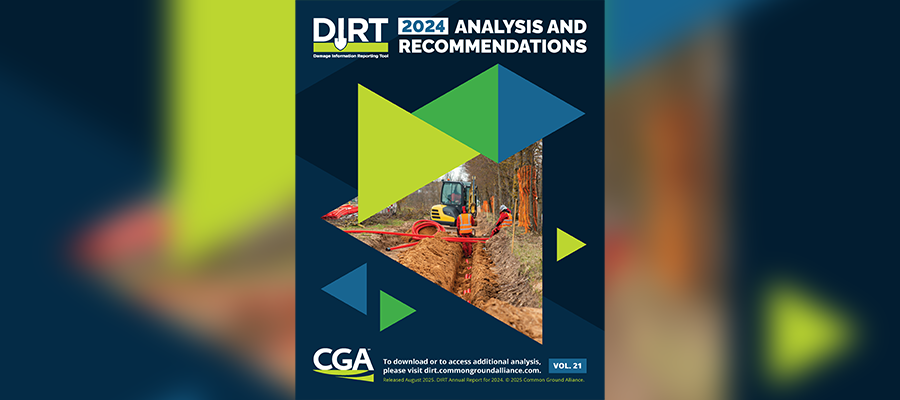
In the latest edition of the DIRT Report, the Common Ground Alliance (CGA) reveals that despite decades of progress in underground infrastructure damage prevention, the industry remains at a critical turning point. The 2024 data show a concerning plateau, and in some cases a reversal, in the trend of reducing damage events to buried utilities. For utility owners and service providers, the findings reinforce that managing risk proactively is more important than ever.
Progress Stalled
According to the 2024 DIRT Report, the CGA Index and the number of unique damage reports both rose slightly in 2024 compared to 2023. This uptick aligns with increases in excavation activity (for example, more 811 tickets and greater construction gross domestic product (GDP)) but it also signals that the damage-prevention efforts to date are no longer driving meaningful reductions.
The report also highlights that certain facility types remain disproportionately affected: telecommunications facilities accounted for 49 % of all damage incidents, and natural gas facilities 39 % (in a subset of data). Meanwhile, water/sewer work emerged as the leading type of excavation associated with damage events (24%), marginally ahead of telecom/cable-TV work (23%).
Root Causes Remain Deeply Entrenched
One of the most telling findings is that the top 10 root causes in the 2024 report accounted for 85 % of all reported damage events — a level of concentration that both underscores risk and offers clarity on where to focus.
These root causes fall into three major groups:
- Notification failures. For example, failing to call 811 before digging.
- Locating practices. E.g., facilities not marked, marked inaccurately, or marking faded/lost.
- Excavation practices. Such as failing to maintain clearance, excavator errors, or not verifying marks.
In particular, the leading individual root causes include:
- Failure to notify 811
- Excavator failed to maintain clearance after verifying marks
- Facility not marked due to locator error and inaccurately marked due to locator error
These consistent patterns year over year show that while many companies understand “what to do,” fewer are consistently doing the right things in the right way at scale.
Locate Timing & Confidence Undermined
Another particularly actionable insight: the report found excavators had an average 38% chance of being unable to begin work as scheduled because their locate requests from 811 centers had incomplete responses.
That unpredictability doesn’t only delay projects: it undermines excavator confidence in the 811 system. And when confidence drops, so does compliance. For example, skipping the call altogether. In short: a broken chain in the locate process creates risk beyond the immediate delay.
What Separates High-Performers
The report’s “Damage Prevention Institute” (DPI) peer-review program provides insight into what differentiates organizations that successfully reduce damages. Among the attributes of high-performers: strong client/utility relationships, comprehensive and repeatable training programs, formal protocols for damage prevention, and high data-quality reporting.
In fact, DPI-accredited contractors even saw reductions in their excavator-attributable damage rates from 2023 to 2024. The overall DIRT Data Quality Index also rose to 71.7 in 2024 (76 for DPI participants), enabling more precise measurement and targeting.
The Way Forward and Your Utility’s Role
The takeaway is clear: incremental improvements are no longer enough. The industry is at a plateau, and moving forward will require systematic, enforceable standards and sector-specific interventions.
For utilities and their service partners, that means:
- Prioritizing high-risk work (water/sewer, telecom/cable-TV) given their outsized share of incidents.
- Ensuring every excavation begins with a verified and timely locate, every time.
- Maintaining and verifying clearance and marks, verifying maps/records, potholing when required.
- Treating damage prevention as a fully integrated part of operations, with formal training, protocols, and performance metrics.
- Embracing data quality and consistent reporting so that root-cause trends can be tracked, measured and improved.
How Bermex Can Help
At Bermex, we understand that reducing risk starts before the first shovel. With over 50 years of experience serving utilities with end-to-end solutions, from damage-prevention field services and 811 management to leak detection, corrosion surveys, and smart-meter deployment, we help utilities turn insights into action.
If your team is looking to reduce infrastructure strikes, improve locate-response outcomes, or embed best-practice processes into your field operations, contact Bermex today to learn how our damage-prevention services can support safer, smarter utility operations and help you align with the key findings of the 2024 DIRT Report.
Related Articles

Every year on Veterans Day, we pause to honor the men and women who have worn our nation’s uniform. They come from every background and every corner of the country, united by a common purpose: to serve something greater than themselves. Their service enriches our organization, and we are grateful for the impact they continue[...]
Read More
By Mark Green, Business Development Manager, Bermex Environmental responsibility and resource conservation are more than good PR; they have become critical, bottom-line imperatives. Utility companies find themselves at the forefront of a sustainability battle that extends far beyond their traditional operational boundaries. At the heart of this challenge lies a deceptively simple yet profound issue:[...]
Read More
By Thomas Gooch, Director of Operations, Bermex Every few minutes across the United States, someone digging into the ground accidentally strikes an underground utility line. The consequences of these incidents extend far beyond the immediate damage to pipes, cables, or equipment. Utility strikes represent an extremely expensive and dangerous infrastructure challenge. The Financial Impact According[...]
Read More
By David Mack, Senior Business Development Manager, Bermex When it comes to preventing utility damages, most organizations focus on technology, training, and regulations. But at the 2025 CGA Conference & Expo, a powerful theme emerged from multiple speakers, including Dr. Victoria Grady of George Mason University: culture, not compliance, is the foundation of lasting safety[...]
Read More